Next-Generation Drone Batteries Promise to Double Flight Times — But What’s the Catch?
Battery technology has long been the binding constraint on commercial drone operations — dictating flight times, payload limits and mission economics in ways that no amount of software optimisation can fully compensate for. A new generation of energy storage solutions is finally beginning to change that calculation.
The standard lithium polymer (LiPo) battery packs that have powered commercial drones for the past decade are approaching the limits of their energy density improvement curve. While incremental gains continue — largely through improved cell chemistry and thermal management — the step-change improvements the industry needs to unlock genuinely long-endurance commercial operations require fundamentally different approaches.
Three technologies are attracting serious commercial development attention: solid-state lithium batteries, hydrogen fuel cells, and hybrid fuel-electric systems. Each offers meaningful performance improvements over conventional LiPo, but each also carries trade-offs in cost, complexity, safety certification and operational practicality that operators need to understand.
Solid-State Batteries: The Most Credible Near-Term Option
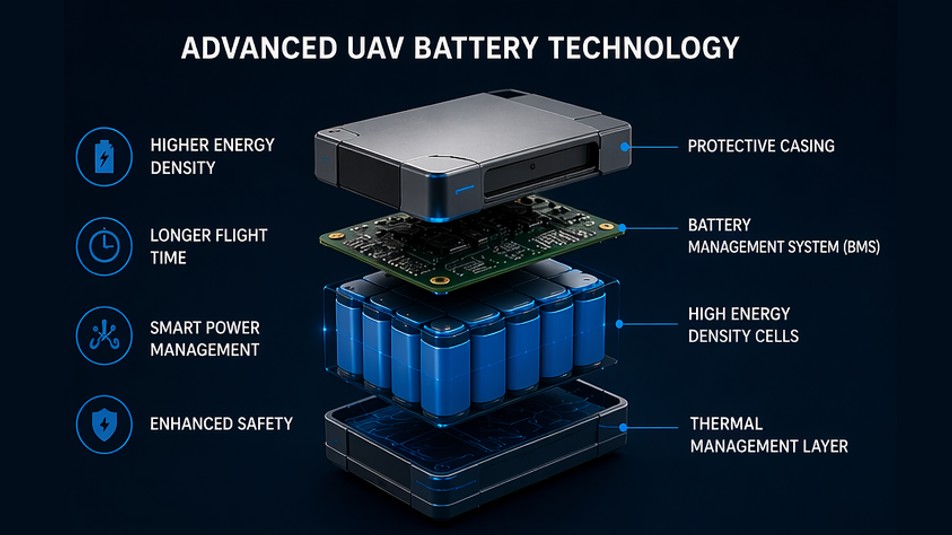
Solid-state lithium batteries — which replace the liquid electrolyte in conventional cells with a solid material — offer higher energy density, faster charging, better thermal stability and longer cycle life than current LiPo technology. For drones, the practical implication is meaningfully longer flight times within similar weight budgets, which translates directly into larger operational areas, fewer battery swap stops on longer missions, and improved payload economics.
Samsung SDI, Solid Power and QuantumScape are among the manufacturers progressing solid-state cells toward commercial production. Several drone manufacturers — including Zipline and Wingcopter — have indicated partnerships or ongoing evaluation programmes with solid-state cell suppliers.
The challenge is production cost and scale. Solid-state cells remain significantly more expensive to manufacture than LiPo equivalents, and production capacity is currently oriented toward the electric vehicle market rather than the smaller, more specialised requirements of UAV operators.
Hydrogen Fuel Cells: Proven Endurance, Complex Operations
Hydrogen fuel cell drones have been commercially available for several years — H3 Dynamics, Intelligent Energy and Doosan Mobility Innovation all produce platforms with demonstrated flight times of two to four hours — but adoption has been slower than expected. The reasons are operational: hydrogen fuel logistics are complex, refuelling infrastructure is sparse, and the regulatory requirements for operating hydrogen-powered aircraft add administrative overhead that many operators find difficult to justify for the available flight time benefit.
What Should Operators Do Now?
For most commercial operators, the practical advice is to monitor the solid-state battery market closely and plan for a meaningful platform refresh cycle in the 2027–2028 window, when the first genuinely commercial solid-state UAV battery packs are expected to reach price points that make upgrade economics compelling.
In the meantime, hybrid approaches — optimising LiPo performance through intelligent battery management, multi-battery hot-swap systems and mission planning that maximises time in the air per battery cycle — remain the most cost-effective route to improving operational efficiency within current technology constraints.
The battery revolution is coming. But as with most things in the drone industry, the timeline is measured in years rather than months — and operators who plan accordingly will be better positioned than those waiting for a technology step-change before committing to their next equipment investment.
See the latest drone hardware at events in our Global Expo Calendar.
View the Expo Calendar →