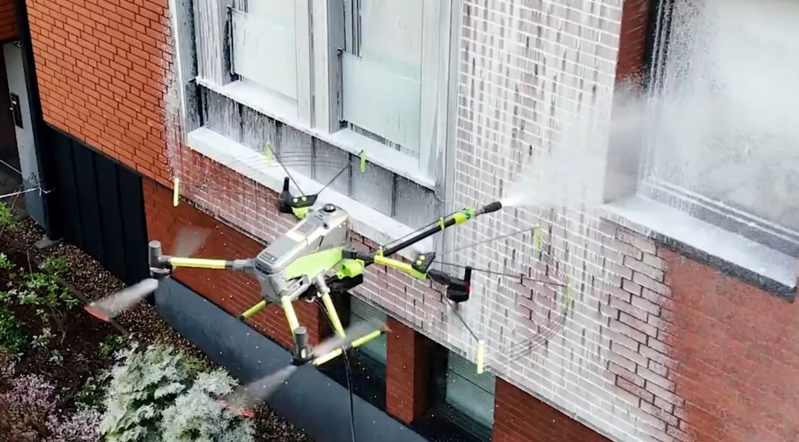
Above the Scaffold: How DCS Is Rewriting the Rules of Building Maintenance
Case Study: DCS – Drone Cleaning Solutions (Poland)
How a Polish drone company is replacing scaffolding and rope access with a machine on a flight path.
For as long as buildings have had glass facades, keeping them clean has meant one thing: putting someone on a rope, a cradle, or a scaffold, hundreds of feet in the air. It’s dangerous, slow, expensive, and disruptive to everyone below. A Polish company called DCS – Drone Cleaning Solutions has built its entire business on the premise that this no longer needs to be true.
The Problem With “The Old Way”
Traditional facade maintenance carries costs that rarely show up on the invoice. Scaffolding and rope-access rigs take days to erect and dismantle before a single window gets cleaned. Certified rope technicians and IRATA-trained crews command premium day rates, and insurance for working at height is one of the most expensive line items in commercial building maintenance. Then there’s the disruption: entryways cordoned off, tenants inconvenienced, and — the risk that no amount of procedure fully eliminates — a person suspended several storeys up, exposed to wind, weather, and mechanical failure.
DCS was founded on the idea that this entire model could be replaced rather than merely improved.
The DCS Approach
DCS operates purpose-built drone systems engineered specifically for professional building cleaning — not adapted consumer drones fitted with a spray nozzle. According to the company, every component is chosen for reliability, performance, and safety in demanding commercial environments, and the systems are built from the ground up around the specific mechanics of facade cleaning.
The result is a platform that removes scaffolding, rope access, and elevated work platforms from the equation entirely. That translates into several tangible advantages the company points to:
- Faster turnaround — no rig-up or rig-down time before and after the job
- Lower cost — no scaffold hire, no rope-access crew premiums
- Reduced environmental impact — filtered water systems enable streak-free cleaning without chemicals on most surfaces, and water use is significantly reduced compared with traditional methods
- Zero risk to workers at height — the single benefit DCS treats as non-negotiable
What’s Under the Hood
DCS describes its systems around a set of core technical pillars:
- Precision flight control — GPS-guided positioning combined with obstacle-avoidance systems for stable, accurate positioning against building surfaces
- Purified water systems — multi-stage filtration for streak-free, chemical-free cleaning on most surfaces
- Layered safety protocols — redundant flight systems, geofencing, and emergency fail-safes designed to protect people and property
- Adaptive high-pressure cleaning — pressure that adjusts automatically for different surfaces, from delicate glazing to raw concrete
- Real-time monitoring — live video feed and telemetry so operators retain full situational awareness throughout the job
- Remote operation — crews control the aircraft from a safe distance without sacrificing oversight
- Extended flight endurance — efficient systems and high-capacity batteries to maximise coverage per flight
- Modular design — interchangeable cleaning heads and tanks that adapt the same platform to different job specs
The company hasn’t published exact figures publicly for flight time, tank capacity, operating range, maximum wind tolerance, cleaning swath width, or water pressure — but the fact that it presents a formal technical specification sheet at all signals an engineering-led, rather than gimmick-led, approach to the market.
How a Job Actually Runs
DCS breaks its process down into three stages:
- Flight preparation — operators configure flight paths, cleaning parameters, and safety zones based on the specific building’s dimensions and layout.
- Automated cleaning — the drone follows its programmed route while operators monitor progress and adjust settings in real time.
- Quality verification — onboard cameras document the results, with AI-assisted analysis used to confirm full coverage before the job is signed off.
Quality control has historically been one of the weaker links in aerial and rope-access cleaning — it’s hard to audit a job that happened forty storeys up. Baking documentation and AI-assisted verification into the workflow gives building owners and facilities managers an evidence trail they simply didn’t have before.
Beyond Cleaning: A Platform, Not a Product
What’s notable about DCS is that cleaning is only one branch of the business. The same drone platform underpins a wider service portfolio:
- Facade cleaning — the core offering
- Disinfection — likely relevant to healthcare, hospitality, and high-footfall commercial buildings
- Drone-based inspection/surveying — using the aircraft for building condition monitoring rather than maintenance
- Training and courses — DCS trains other operators, suggesting an ambition to seed the wider market rather than simply compete in it
- Franchising — a route to scaling the model geographically without DCS having to own every operation itself
The franchise and training arms are the clearest tell that DCS sees itself less as a regional cleaning contractor and more as the architect of a new maintenance category — one it wants to license out and scale, not just perform.
A European Base with Global Ambitions
DCS is headquartered in Gdynia, Poland, with a presence across Warsaw, Gdynia, and Kraków, and describes Europe as its home market. The company states it has been developing its technology for six-plus years — a meaningful runway in a sector where most competitors are only just starting to experiment with drone-based facade work.
Why This Matters for the Wider Industry
For property owners, facilities managers, and building maintenance contractors, the DCS model is a preview of where the sector is heading:
- Risk removal, not just risk reduction. Most safety innovation in height-work has focused on better harnesses, better training, better procedure. DCS’s pitch is structurally different: remove the person from the hazard altogether.
- Cost and timeline compression. Removing scaffold and rope-access logistics doesn’t just cut cost — it cuts the calendar time a building spends visibly under maintenance, which matters to landlords managing tenant perception and occupied buildings.
- Sustainability as a byproduct, not a bolt-on. Reduced water use and the ability to avoid chemicals on many surfaces line up neatly with ESG reporting requirements that commercial landlords increasingly have to meet.
- A scalable, licensable model. By pairing the technology with training and franchising, DCS is positioning itself as infrastructure for an emerging industry, not just one contractor within it.
The Bigger Picture
Drone-based facade maintenance is still an emerging category, and DCS is one of a small number of companies trying to professionalise it — moving it from a novelty demonstration to a certified, repeatable, insurable commercial service. Whether DCS or a competitor ultimately sets the industry standard, the direction of travel looks clear: height work that used to require a person on a rope is steadily becoming a job for a machine on a flight path, with a human safely on the ground directing it.
For an industry that has accepted working-at-height risk as an unavoidable cost of doing business for decades, that’s not an incremental improvement. It’s a different starting assumption entirely.
Source: DCS – Drone Cleaning Solutions, dcs-drone.com